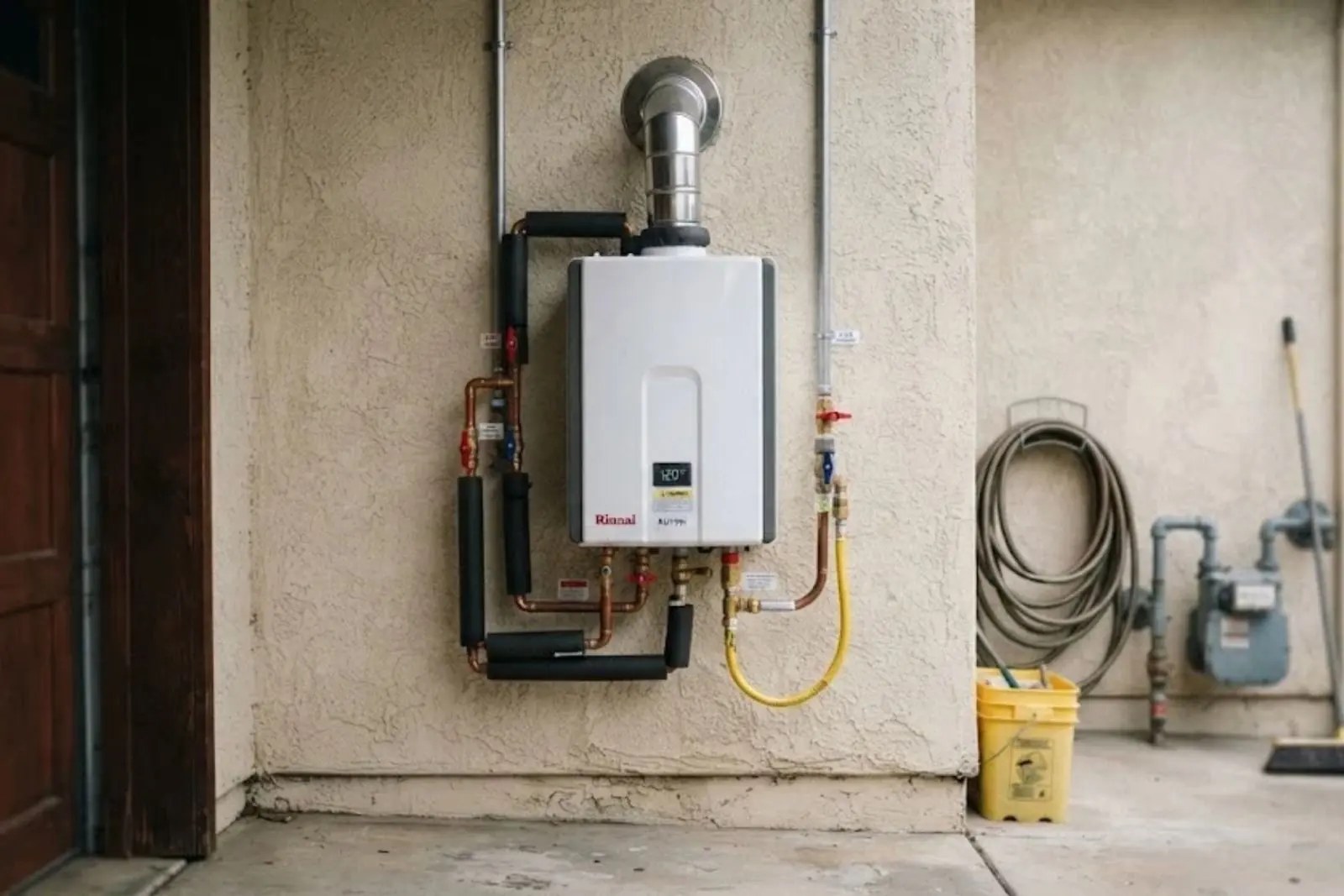
A tankless water heater heats water as it flows through the unit, so there is no tank to run out. We install, descale and repair tankless units for Marlboro homes, and we are straightforward about when tankless is a good fit and when a traditional tank still makes sense.
If you are weighing a switch, this page covers the supply requirements, the maintenance, and the common reasons a tankless unit stops delivering hot water.
Is tankless right for your house?
A big household
Several bathrooms and back to back showers are where continuous hot water pays off.
Limited space
A wall mounted unit frees up the floor area a tank occupied.
Supply limits
Tankless needs a larger gas line or substantial electrical capacity, so check before you commit.
Replacing an old tank
The swap is a natural time to upgrade if the venting and supply can handle it.
What a tankless installation needs
The main differences from a tank are the supply and the venting. Gas units burn more fuel at once, so the gas line must be large enough. Electric units draw heavy current, so the panel and wiring must be able to carry it.
Venting for gas tankless is specific to the model and must be installed as the manufacturer requires. We confirm all of this before quoting, because a unit that cannot be supplied properly will not perform.
| Consideration | Gas tankless | Electric tankless |
|---|---|---|
| Supply | Gas line sized for the unit | Dedicated high amperage circuit |
| Venting | Required, model specific | Not required |
| Best fit | Larger households | Smaller loads or point of use |
| Check first | Gas meter and line size | Electrical panel capacity |
Maintenance that keeps it running
Mineral scale builds up inside the heat exchanger and slows flow. Descaling clears it and restores performance, and many manufacturers recommend periodic flushing. How often depends on your water.
Marlboro Township's water comes from wells and from Middlesex Water Company, per the township's 2025 Water Quality Report. The report does not give a hardness figure we can quote, so test your tap or ask your water utility how hard your water is. Harder water means scale builds faster.
Common tankless problems
- Lukewarm water that never gets hot: scale or a failed sensor.
- Error codes on the display: look up the code, then call us for the fix.
- No ignition on gas units: gas supply, venting or igniter.
- Short bursts of hot then cold: flow rate too low for the unit to fire.
Tankless unit not heating?
Call us and describe the error or the symptom.
What affects the price
You hear the full price, including supply upgrades, before work begins.
Sizing a tankless unit
Tankless units are rated by how much hot water they can deliver per minute at a given temperature rise. Winter groundwater is colder than summer, so a unit that handles a household in July may struggle in January.
We count the fixtures that run at once, such as a shower, a dishwasher and a washing machine, and size the unit to that load plus a margin. A unit that is too small will deliver lukewarm water at peak times.
Related pages
Compare with a traditional tank installation or see water heater repair for tank problems. We service tankless units in Marlboro, Holmdel and Freehold Township.
Frequently asked questions
Yes. Descaling the heat exchanger is the usual task, and how often depends on how hard your water is.
Often yes if it is sized for your peak demand and your supply can feed it. We size the unit to how many fixtures run at once.
Codes point to a cause such as ignition, flow, venting or temperature. The manual lists them, and we can diagnose and fix the underlying problem.
Often yes, because tankless units burn more gas at once than a tank. We check your meter and line before quoting.
It depends on your household and your supply. For some homes it solves hot water runs out problems, and for others a modern tank is simpler.
Usually we install a tank in an emergency and plan tankless as a scheduled upgrade, because supply and venting need preparation.