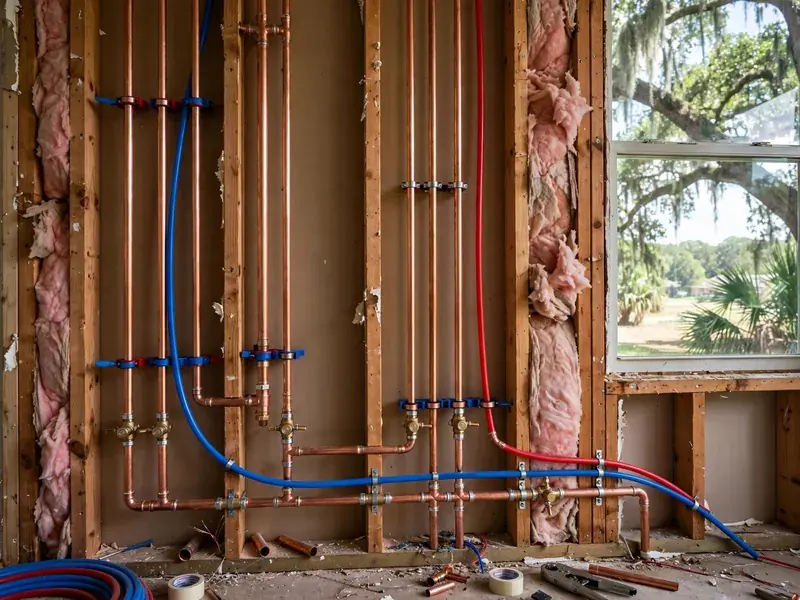
Repiping means replacing the old supply pipes in a house with new ones, either whole house or in sections. It is a bigger decision than a repair, and it makes sense when leaks keep returning, water looks discolored or pressure has faded because of corroded pipe.
This page explains the signs, the materials we use, what a repiping day looks like in an occupied home and how we keep the work as clean as possible.
Signs your house may need repiping
- Pinhole leaks that keep appearing in different spots.
- Rusty or brown water from several faucets.
- Low pressure throughout the house, not just at one fixture.
- Visible corrosion or crusty buildup on exposed pipe.
- Pipe material that is known to fail, such as old galvanized steel or polybutylene.
PEX or copper
| Material | Strengths | Consider |
|---|---|---|
| PEX | Flexible, runs through walls with fewer joints, resists freeze splitting better than rigid pipe | Not for outdoor exposure to sunlight, and must be installed to code |
| Copper | Long track record and durable | Costs more, and acidic water can wear it over time |
Both are accepted materials. We explain which suits your house, your budget and the way your walls are built, and you choose.
Repipe all of it or only part
A partial repipe replaces the worst section, such as one bathroom group or the lines to a single wing. It suits a house where only part of the system has failed.
A whole house repipe replaces everything and avoids repeated repairs. If the pipes are the same age and material throughout, one pinhole leak is often followed by another, and a full repipe is the better value over time.
How the work goes
- 1
Walk through and plan
We look at every pipe we can reach and plan the route for new lines.
- 2
Rough in the new system
We run new lines, often through attics, basements and existing walls.
- 3
Cut in and connect
We swap the fixtures over and test the system under pressure.
- 4
Patch and finish
We repair access holes and clean up. Painting or finish work is not included unless we agree.
Repiping and Marlboro housing
Marlboro's suburban boom put up many homes in the 1970s through 1990s. Pipe materials from that period vary, and a house's original supply lines may now be several decades old.
Whether a repipe needs a permit and inspection depends on the work, so ask the Marlboro Township Construction Division at (732) 536-0200, extension 1800. We explain what we have seen required on similar jobs.
Wondering if it is time to repipe?
Call and we will look at what is failing.
What affects the price of repiping
You receive a clear price in writing before we start, and we explain what drywall repair is and is not included.
Living in the house during a repipe
Repiping takes planning but it does not mean leaving your house. We set a schedule for the days water is off, keep an area open for temporary use where possible and protect floors and furniture in the work areas.
Expect some noise and dust when we open walls or drill through framing. We contain it where we can and clean up at the end of each day. You see the schedule before work begins so you can plan around it.
Related services
If a pipe has burst, see burst pipe repair. To find where a leak starts, see leak detection. We repipe homes in Marlboro, Holmdel and Manalapan.
Frequently asked questions
It depends on the size of the house and the access. Many jobs take a few days, and we plan the schedule with you.
Usually yes, though water is off for periods of the work. We plan so you are not without water for long stretches.
Both are accepted and widely used. PEX is easier to run through walls, and copper has a long history. We explain which suits your house.
Some access is needed. We use existing openings, attics and basements where possible to limit patching.
Permit rules vary by the work, so ask the Marlboro Township Construction Division at (732) 536-0200, extension 1800.
We can identify the material on site by looking at exposed pipe and fittings.