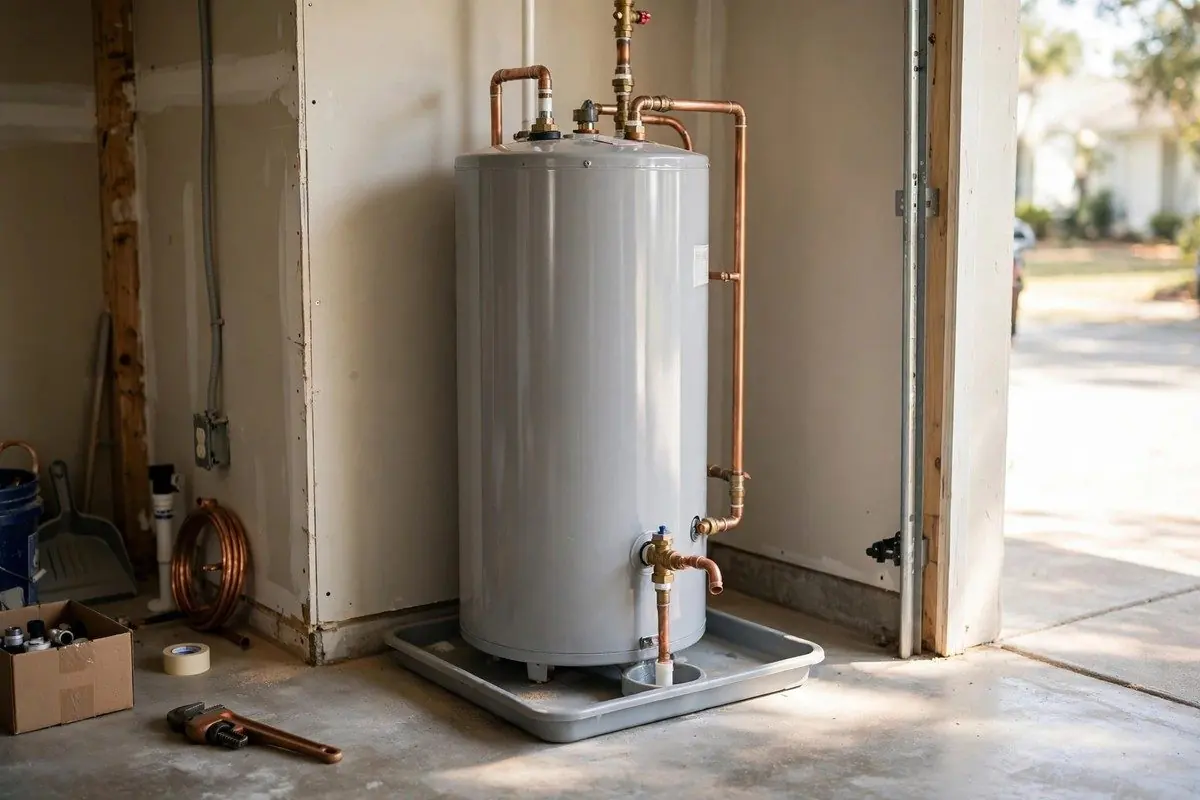
A water heater usually needs replacing when it leaks from the tank, when repairs start piling up or when it no longer keeps up with your household. Age is a clue, not a verdict. Most tank heaters last roughly 8 to 12 years, but water quality, maintenance and size all matter.
This guide lists the signs that point to replacement, how to read the age on your unit and how to decide between repair and a new heater.
Signs it is time to replace
- Water pooling at the base of the tank, which means the tank itself has failed.
- Rusty or discolored hot water, especially if it persists.
- Rumbling or popping sounds from sediment hardened at the bottom.
- Not enough hot water, or water that runs out quickly.
- Repeated repairs on the same unit.
- A unit older than the typical lifespan.
How to find the age of your water heater
The data plate on the side of the tank has a serial number. Many manufacturers encode the month and year in the first characters. A letter often stands for the month and the following digits for the year. Because formats differ, look up your brand's format or ask us to read it.
Take a photo of the plate. It also lists capacity, fuel type and the model you will need for parts or a replacement.
Repair or replace
| Situation | Usually better | Why |
|---|---|---|
| Leaking tank | Replace | The tank cannot be repaired |
| Failed thermostat or element | Repair | Inexpensive parts |
| Unit near end of life with repeated faults | Replace | Repairs keep recurring |
| Pilot or igniter trouble | Repair | A part issue, not a tank issue |
| Undersized for the household | Replace | A larger unit solves the cause |
A leak at a fitting or valve is different from a leak through the tank. Our water heater repair visit checks which one it is.
What a replacement involves
- 1
Choose the type
Tank, tankless or hybrid, matched to fuel and household size.
- 2
Drain and disconnect
The old unit is drained and removed.
- 3
Install and connect
The new unit is set, connected, vented and fitted with a relief valve and expansion control where required.
- 4
Test and explain
We check temperature and pressure and show you the shutoffs.
Our water heater replacement page explains the process and what to expect on the day.
Choosing the replacement
| Type | Strength | Consider |
|---|---|---|
| Standard tank | Lower upfront cost, simple | Standby heat loss and a limited supply |
| Tankless | Continuous hot water, saves space | Higher install cost, venting and descaling |
| Hybrid heat pump | Efficient in the right space | Needs room and air flow |
Match the unit to your household. A rising number of showers, a new bathroom or a larger tub all change how much hot water you need. Tell the installer so they size it correctly.
Our tankless water heater page explains when that choice makes sense.
What to do if it is leaking right now
- 1
Cut the power or gas
Turn the breaker off or the gas control to off or pilot.
- 2
Close the cold supply
The shutoff valve above the tank stops more water from entering.
- 3
Contain the water
Mop up and move belongings away from the floor.
- 4
Call for help
Tell us the type of unit and where the water is coming from.
A leaking tank is an emergency because stored water can spill for hours and damage floors and walls below. Acting quickly limits the damage.
Safety checks that come with a new heater
A new water heater installation should include a temperature and pressure relief valve with a proper discharge pipe, a shutoff on the cold supply and correct venting for gas units. Ask whether an expansion tank is needed on your system, and whether the old heater will be hauled away.
The installer should explain where the shutoffs are and how to set the temperature. A setting that is too high raises scald risk, and one that is too low can be a concern in a tank. Ask what setting they recommend for your household.
Planning ahead saves a cold shower
The best time to replace a water heater is before it fails. A planned replacement lets you choose the type, compare quotes and schedule the work. An emergency replacement happens on someone else's timetable and with fewer choices.
If your unit is old, ask for an assessment now. Knowing the condition helps you budget and avoids a rushed decision on a cold morning.
Keep the paperwork
Save the receipt, the model and serial number and the warranty terms for your new heater. Note the install date on the tank with a marker. When something fails years from now, this information tells you whether a warranty still applies and which parts you need.
Water heater failing?
Call and we will tell you whether to repair or replace.
Extending the life of a heater
Flush sediment from the tank once a year. Check the anode rod every few years, because it protects the tank from corrosion and wears out first. Keep the temperature at a safe setting, and make sure the relief valve works.
These steps cost little and often add years to a heater. If your water is hard, they matter even more.
Water heaters and water quality in Marlboro
Marlboro Township's water comes from township wells and from Middlesex Water Company, according to the 2025 Water Quality Report, and the report gives no single hardness figure we can quote for every address. Test your tap or ask your utility, because hard water leaves sediment in tank heaters and shortens their life.
Plumbing work in Marlboro is reviewed through the Construction Division at (732) 536-0200, extension 1800, and permit rules vary by job, so ask before you replace a unit.
Questions homeowners ask
Many tank heaters last roughly 8 to 12 years, though water quality and maintenance change that.
If the tank leaks, replace it. If the issue is a part such as an element or thermostat, a repair may be worth it.
Rust colored water, popping sounds, leaks at the base and running out of hot water quickly are common.
Yes. Turn off the water supply to the unit and the power or gas, then call.
Permit rules vary, so ask the Construction Division at (732) 536-0200, extension 1800.