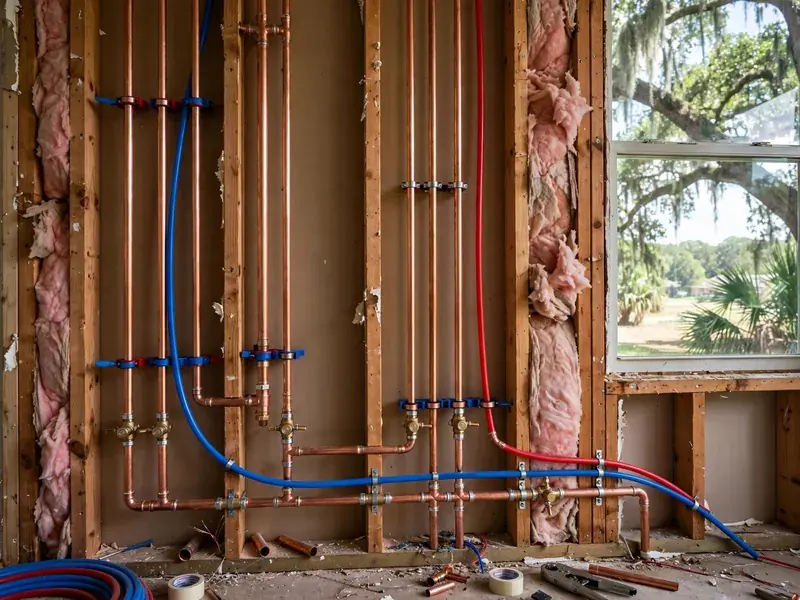
Repiping a house with PEX means replacing old supply lines with flexible cross-linked polyethylene tubing, usually through attics, basements and existing wall cavities. It is a project for a licensed plumber, but understanding the process helps you plan the work and compare quotes.
This guide explains why homeowners choose PEX, how the system is laid out, what happens during the work and what to ask before you sign.
Why PEX is common for repipes
PEX bends around corners, so it needs fewer fittings than rigid pipe. That reduces the number of joints that can leak and makes it possible to run new lines through walls without opening them completely.
It also resists corrosion and tolerates freezing better than rigid pipe, since it can expand slightly. It is not for outdoor use in direct sunlight, and it must be installed according to code and the manufacturer's instructions.
How a PEX system is laid out
| Layout | How it works | Consider |
|---|---|---|
| Trunk and branch | A main line feeds smaller lines to fixtures | Familiar and uses less tubing |
| Home run manifold | Each fixture has its own line from a central manifold | More tubing but steady pressure and individual shutoffs |
| Hybrid | Combination of both | Fits many houses |
A manifold system gives you a shutoff for each fixture or group, which is handy when a leak happens. The tradeoff is more tubing and a place to mount the manifold.
What happens during the repipe
- 1
Plan the routes
We look at the existing system and plan where new lines will run.
- 2
Shut off and drain
Water is turned off and the old system is drained.
- 3
Install the new lines
PEX is run, secured and connected at each fixture.
- 4
Test and patch
We pressure test, then patch access openings.
The work usually takes a few days in an average house. You will be without water for periods, and we plan around your schedule. Our repiping page explains how we handle an occupied home.
Questions to ask before you hire
- Is the quote whole house or partial, and which fixtures are included.
- Which PEX type and fittings will be used.
- What is included for drywall repair and painting.
- Will a permit and inspection be needed, and who arranges them.
- How long will the water be off each day.
Signs your pipes may be due
- Discolored or rusty water that returns after running the tap.
- Low pressure at several fixtures that cleaning aerators does not fix.
- Pinhole leaks, green staining on copper or repeated repairs in the same system.
- Stains on ceilings or walls near supply lines.
- A plumber who finds corrosion or failing fittings at multiple points.
One leak does not mean the whole house needs new pipe. A pattern of leaks in different places does. A leak detection visit can show whether the problem is local or spread through the system.
Preparing your home for the work
Clear the areas around the water heater, under sinks and the paths to attic or crawl space access. Move valuables out of rooms where walls will be opened. Tell us about pets, home offices and anyone who needs water at set times.
Plan for short periods without running water. We usually restore water at the end of each working day so the house stays livable, but ask for the plan in writing.
After the repipe
Expect a final pressure test and a walk through of every fixture. Ask where the new shutoffs and manifold are, and take a photo of the layout before walls are closed. That photo is useful for any future plumber.
Flush the lines and clean faucet aerators once water is back, because small debris can loosen during the work.
What a repipe does not change
A repipe replaces the supply side only. Drains, vents and fixtures stay as they are unless you add them to the scope. If your fixtures are old, a repipe is a good time to replace shutoff valves and supply lines, because the walls are already open.
Tell us if you plan a bathroom or kitchen remodel soon. Doing both together saves opening the same walls twice.
Questions about water quality after a repipe
Some homeowners notice a plastic taste for a short time after a new system goes in. Flushing the lines for several minutes at each fixture usually clears it. If the water looks cloudy, aerators may have caught debris, so remove and rinse them.
If a taste or color persists, tell us. We can check the connections and flush the system again.
Comparing PEX with copper
| Feature | PEX | Copper |
|---|---|---|
| Installation | Flexible, fewer fittings | Rigid, soldered joints |
| Corrosion | Resists scale and pitting | Can corrode in some water |
| Freeze tolerance | Expands slightly | More likely to split |
| Outdoor exposure | Not for direct sunlight | Handles outdoor runs |
Both are accepted materials when installed correctly. The right choice depends on the house, the local water and your plumber's experience.
Thinking about a PEX repipe?
Call and we will look at your pipes and explain your options.
Repiping in Marlboro homes
Marlboro's suburban growth put up many homes through the 1970s, 1980s and early 1990s, and supply pipe materials from that period vary. A house built in that era may have copper that is now old or an earlier plastic that is more prone to failure.
Ask the Marlboro Township Construction Division at (732) 536-0200, extension 1800, whether your project needs a permit. Plumbing in Marlboro is reviewed before a Certificate of Occupancy, and the township requires a final inspection for new work.
The township's 2025 Water Quality Report states there are no lead service lines in its territory. That is about the line serving the house, so ask your utility if you want to confirm what serves your property.
Questions homeowners ask
Many houses take a few days, depending on size and access. We give you a schedule before we start.
Usually not. We plan the water shutoffs, and you can stay in the house.
PEX approved for potable water is widely used. We install approved tubing and fittings.
Yes. A partial repipe replaces the worst section, which suits houses where only part of the system has failed.
Permit rules vary by the work, so ask the Construction Division at (732) 536-0200, extension 1800.