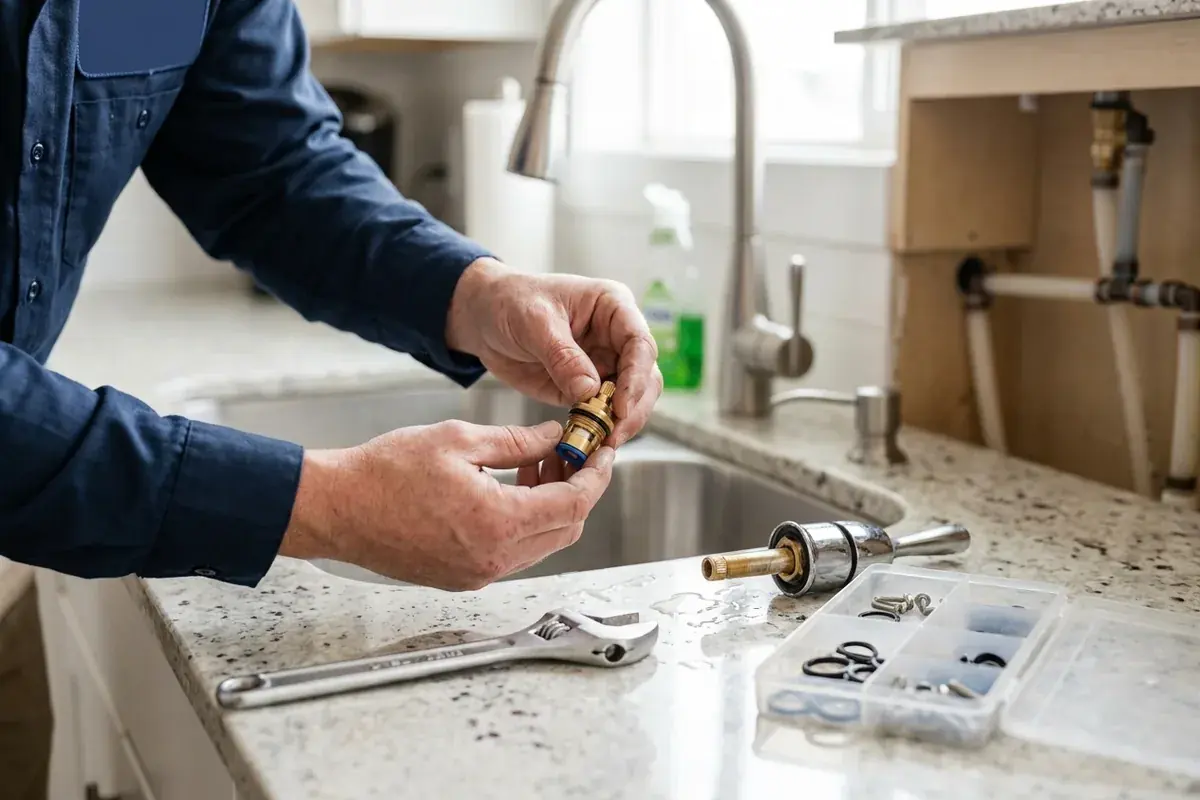
Most kitchen faucet leaks and drips come from a small group of parts: the cartridge, the O-rings, the aerator and the supply lines. Knowing which part belongs to which symptom helps you decide whether to buy parts yourself or call a plumber.
This guide matches each common symptom with the part that usually causes it, explains how to identify the faucet type and shows when replacing the faucet is the better answer.
Symptom to part
| Symptom | Likely part | Typical fix |
|---|---|---|
| Drip from the spout | Cartridge or washer and seat | Replace the cartridge or the seals |
| Leak at the base of the handle | O-rings or packing | Replace the O-rings |
| Weak or sideways spray | Aerator | Clean or replace it |
| Water under the sink | Supply lines or connections | Tighten or replace lines |
| Handle hard to turn | Worn cartridge or mineral buildup | Clean or replace the cartridge |
Identify your faucet first
There are four common designs: compression, cartridge, ball and ceramic disc. Compression faucets have separate hot and cold handles and use rubber washers. Cartridge and ball faucets are single handle styles. Ceramic disc faucets feel smooth and use sealed discs.
Look for the brand and model on the faucet or under the sink. Take the old part with you when buying a replacement so the match is exact.
Basic repair steps
- 1
Shut off the water
Close the valves under the sink and open the faucet to release pressure.
- 2
Plug the drain
A small part dropped into an open drain is hard to retrieve.
- 3
Remove the handle
Pop the cap, loosen the set screw and lift the handle away.
- 4
Replace the worn part
Take out the cartridge or seals, fit the new ones in the same order and reassemble.
If a drip returns after a new cartridge, the valve seat may be pitted. At that point, a replacement faucet is usually more sensible than more parts.
Our faucet repair page explains how we decide between repair and replacement.
When replacing the faucet is smarter
- Corroded or cracked body.
- Parts for the model are no longer available.
- Repeated leaks after repair.
- Finish worn off or hard water scale that will not clean.
- You want a different style or a pull down sprayer.
Plan around the sink opening. A faucet with a different number of holes may need a deck plate. A plumber can handle stuck nuts and tight cabinet spaces. If a leak seems to come from the pipes rather than the faucet, our leak detection visit can find it.
Tools and supplies to have ready
- Adjustable wrench and a set of hex keys.
- Flat and Phillips screwdrivers.
- Plumber's grease and a small container for parts.
- A flashlight and a towel under the sink.
- Replacement cartridge, O-rings and an aerator that match your faucet.
Take photos at each step so reassembly is easy. Lay parts out in the order they came off. Hand tighten first, then give a final quarter turn with the wrench, because overtightening cracks plastic and strips brass.
Common mistakes
The most common mistake is skipping the shutoff valves and finding out the hard way how much water the line holds. The second is mixing up parts that look alike. The third is forcing a stuck handle and snapping the stem.
If a part will not budge, stop. A plumber has penetrating products and pullers that remove stuck cartridges without damaging the faucet body.
Faucet finishes and care
Finish affects how a faucet ages. Chrome and stainless are the easiest to maintain. Brushed nickel hides spots well. Matte black and brass finishes look striking but can show wear if cleaned with harsh products. Use mild soap and a soft cloth rather than abrasive powders or strong acids.
Clean the aerator every few months by unscrewing it, soaking it in vinegar for an hour and brushing out debris. This simple habit keeps flow even and slows scale buildup.
Checking the shutoff valves
Before you start any faucet repair, test the shutoff valves under the sink. Old valves can stick, leak when turned or fail to stop the flow. If a valve will not close, shut off the main instead and plan to replace the valve after the repair.
Replacing a failed shutoff valve is a short plumbing job that pays off the next time you need to work on the sink.
Cost of waiting
A drip may seem minor, but it wastes water around the clock and wears the seat where the water passes. Over time that can turn a cheap cartridge swap into a faucet replacement. It can also stain the sink and hide a deeper plumbing leak below.
Fix it when it starts. Most drips are quick repairs when caught early.
Keep the old parts
Bag the removed cartridge or washers and label the bag with the faucet location and date. If the new part does not match, the old one is the quickest way to find the right replacement. It also shows a plumber exactly what wore out.
Match the faucet to the sink
If you decide to replace, count the holes in the sink or counter and measure the spacing. A faucet that needs fewer holes can use a cover plate, while one that needs more cannot be installed without drilling. Bring the measurements when you shop.
Faucet still dripping?
Call and we will repair or replace it.
Faucets and water quality in Marlboro
Marlboro Township's 2025 Water Quality Report does not give a single hardness number we can quote for every home, because supply comes from township wells and from Middlesex Water. If you see white scale on your faucet or aerator, test your tap or ask your utility about hardness where you live.
Scale builds up inside aerators and cartridges and can make a good faucet feel worn. Cleaning the aerator every few months can postpone repair.
Questions homeowners ask
A worn cartridge, washer or seat is the usual cause. The drip is water slipping past a seal that no longer closes.
Yes. Close the shutoff valves under the sink. If there are none, shut off the main.
Identify the brand and model, or remove the old cartridge and match it exactly.
If parts are available and the body is sound, repair is fine. If it is corroded or leaks repeatedly, replacement saves time.
Scale can clog aerators and wear cartridges. Test your tap or ask your utility about hardness at your address.