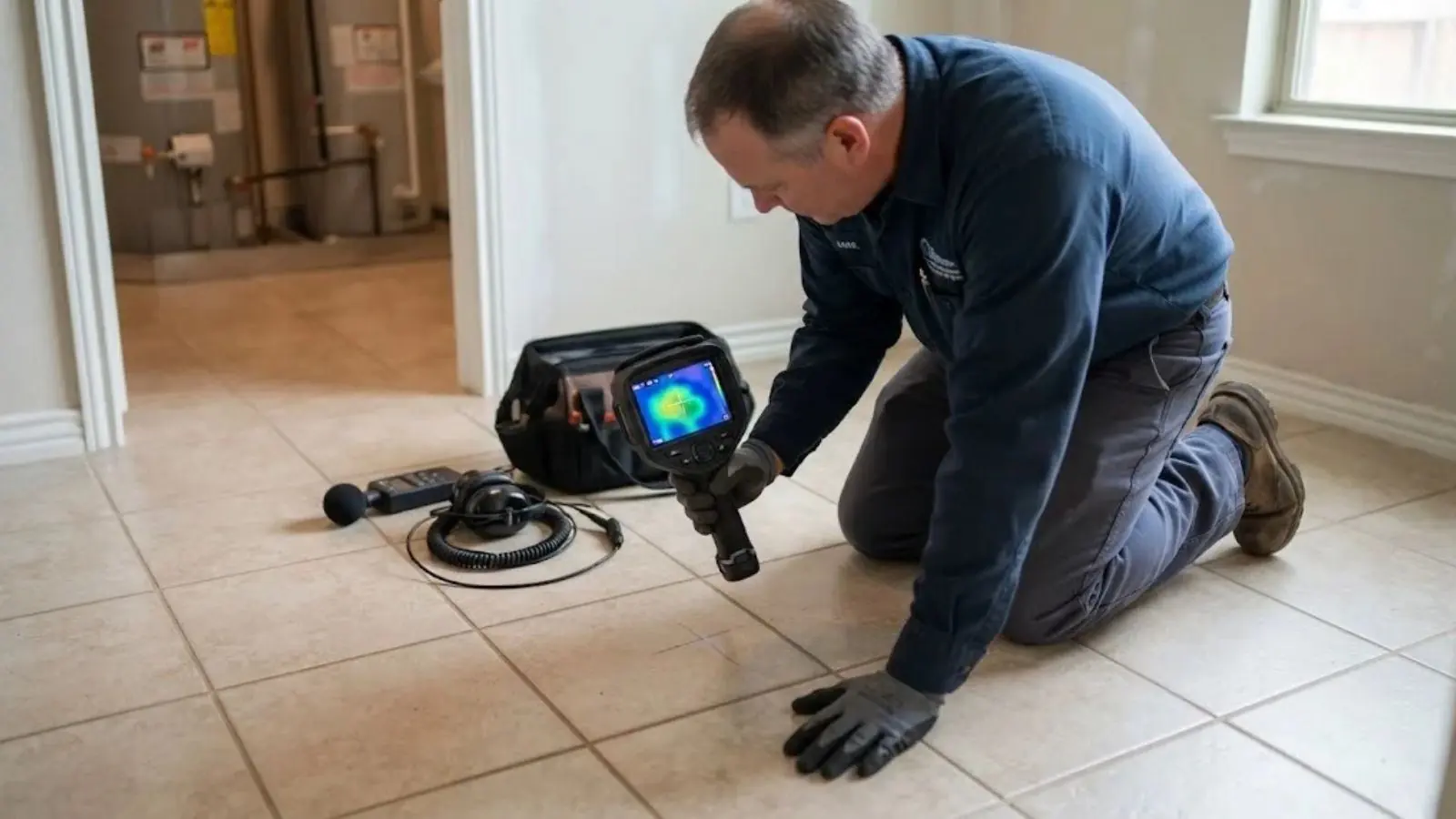
An underground water leak is a leak in the supply line between the street and your house, or in a pipe buried in the yard or under the slab. You cannot see it, but the signs show up in your water meter, your bill and the ground. If you suspect one, a meter test is the first and cheapest step.
This guide explains the warning signs, the meter test, how professionals pinpoint a hidden leak and what repair options exist.
Signs of a hidden leak
- A water bill that rises without any change in use.
- A meter that keeps moving when every fixture is off.
- A soggy patch, lush green strip or sinkhole in the yard.
- Reduced pressure at fixtures, especially after the main shutoff.
- The sound of running water when nothing is on.
The meter test
- 1
Turn everything off
Stop all water use inside, including ice makers and irrigation.
- 2
Read the meter
Note the dial and any small leak indicator, which is often a small triangle or wheel.
- 3
Wait
Leave the water off for an hour or two, or overnight.
- 4
Read it again
If the dial or indicator moved, water is going somewhere.
To tell whether the leak is inside or outside, close the main shutoff valve at the house and check the meter again. If it still moves, the leak is on the buried line between the meter and the house.
How a leak is located
| Method | What it does | Best for |
|---|---|---|
| Acoustic listening | Microphones pick up the sound of escaping water | Pressurized lines |
| Pipe locating | Traces the route of buried pipe | Planning the dig |
| Pressure testing | Isolates sections to see where pressure drops | Narrowing the area |
| Thermal imaging | Shows temperature differences from water | Slab and wall leaks |
Pinpointing matters because it means a small dig instead of a large one. Our leak detection page describes the process.
Repair options
Once the leak is found, repair depends on the pipe and its depth. A short section can be replaced after a small excavation. A long deteriorated line may be better replaced as a whole. Our water service line repair page explains how we approach each case.
Call 811 before any digging so that buried utilities are marked. Ask who owns which section of the line, because responsibility is often split between the utility and the homeowner.
What to do while you wait for a visit
If the leak seems large, close the main shutoff at the house and call us. For a small suspected leak, leave the water on, note the meter reading and avoid using water for a set period to confirm. Take photos of any wet ground, and write down the time you noticed it.
Keep children and pets away from soft or sinking ground. Do not dig near the line yourself, because buried gas, electric and communication lines may be close by.
Why a small leak is still worth fixing
- Constant leaks wash soil from under pipes and slabs.
- Water can enter a crawl space or basement and cause damp conditions.
- A leak wastes water and shows up on every bill.
- Pressure loss can affect appliances and fixtures.
- Waiting tends to turn a spot repair into a larger one.
A hidden leak does not fix itself, and the longer it runs the more soil it moves. Acting early usually keeps the repair small.
Reading your water meter
Most residential meters have a register that counts gallons or cubic feet and a small flow indicator that spins when any water moves. Find the meter in the basement, in a box near the street or in a utility closet. Clean the cover and look for the indicator.
If your utility reads the meter remotely, the display may show a flow flag as well. Ask the utility how to interpret it, because models differ.
Leaks inside versus outside
| Clue | Points to | Next step |
|---|---|---|
| Meter moves with main valve closed at the house | Buried line outside | Leak survey of the service line |
| Meter stops with main valve closed | Leak inside the house | Check fixtures, then inspect the piping |
| Only hot water is affected | Water heater or hot line | Inspect the heater and hot pipes |
| Wet spot on a basement slab | Pipe under the slab | Thermal or acoustic tracing |
What a leak survey records
A thorough survey ends with something you can keep. That includes the meter readings, the area where the leak was found, the pipe material and depth and photos where possible. This record helps with any repair quote and with conversations with the utility or your insurer.
Ask for it in writing. If a company gives only a verbal answer, you have little to compare against another bid.
Watch the bill
Compare your water bills month to month, adjusting for the season. A steady climb with no change in habits is one of the earliest signs of a hidden leak. Catching it early often keeps the repair small and the soil under your lawn intact.
Think you have a hidden leak?
Call and we will help you confirm it and find it.
Water supply facts for Marlboro homeowners
Marlboro Township's Water Utility Division serves much of the town from five wells in the Potomac-Raritan-Magothy aquifer, and about 75 percent of its supply is purchased from Middlesex Water, according to the township's 2025 Water Quality Report. The report also states there are no lead service lines in its territory.
If you see water coming up in the street or suspect the problem is on the utility side of the meter, call the Water Utility Division at (732) 536-0188. After hours, the township police can be reached at (732) 536-0100. For the private side, a professional leak survey is the next step.
Questions homeowners ask
A moving water meter with all fixtures off, a wet or unusually green patch of lawn and a rising bill are the main signs.
Ownership is often split. The utility usually handles its side up to the meter, and the homeowner handles the rest. Ask your utility to confirm.
Often yes. Acoustic and thermal tools can narrow the location before any work begins.
No. Water can drain away through soil, so a serious leak can stay invisible for a long time.
Call the Marlboro Township Water Utility Division at (732) 536-0188, or the township police at (732) 536-0100 after hours.