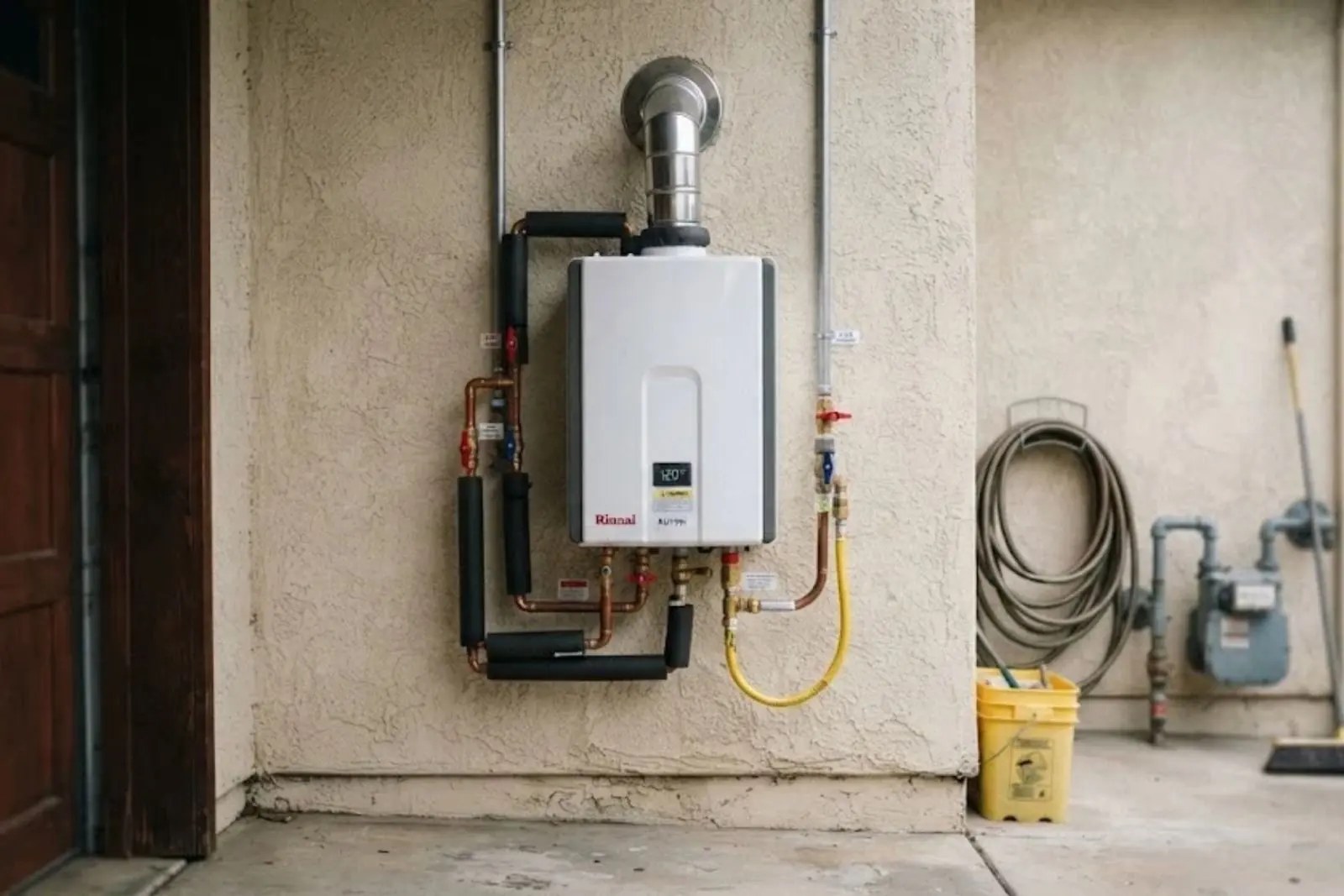
A tankless water heater costs more to buy and install than a tank heater of the same capacity, and it can cost less to run in a household with modest hot water use. We do not publish one price here, because the total depends on the unit, the fuel, the venting and the work needed to make your house ready.
This guide lays out the cost drivers, what sits in a quote and how to judge payback without guessing.
What goes into the price
| Item | Why it affects cost | Notes |
|---|---|---|
| The unit | Capacity and efficiency vary | Larger households need higher flow |
| Fuel | Gas, electric or propane | Gas needs venting and a gas line |
| Venting | Special venting is often required | Depends on location |
| Gas line or electrical | Many tankless units need larger supply | Can be a major item |
| Water treatment | Hard water needs protection | Adds a filter or flush setup |
| Permits and inspection | Local rules apply | Ask the town |
Most of the price difference between quotes comes from the supporting work, not the unit itself. A low quote that skips a gas line upgrade or a vent is not really lower.
Running cost and payback
Tankless heaters heat water on demand, so they avoid the standby loss of a tank. A household that uses little hot water gains the most. A large family with showers that overlap may need a bigger or second unit.
Payback depends on your usage, the fuel prices in your area and the real efficiency of the model. Ask the installer to show their assumptions in writing rather than quoting a flat savings figure.
Questions to ask
- What flow rate does this unit deliver at our incoming water temperature.
- Is a new gas line, vent or electrical circuit needed, and is it in the quote.
- How is hard water handled, and what is the maintenance plan.
- What does the manufacturer warranty cover.
- Who pulls the permit and arranges the inspection.
When a tank heater is the smarter choice
If your house has limited space for venting, a small household or a tight budget, a tank unit may be the better fit. Tankless is not always cheaper over time. Our tankless water heater page explains who tends to benefit most, and our water heater installation page covers the tank option.
Sizing the unit to your household
Tankless heaters are rated by how many gallons per minute they can deliver at a given temperature rise. Cold incoming water in winter lowers the rate, so a unit that looks fine on paper may struggle in January. Ask the installer to size for your coldest water, not an average.
List the fixtures you expect to run at once. A shower, a dishwasher and a washer together can exceed the flow of a small unit. If you run two bathrooms at the same time, say so.
Planning the install
- 1
Survey
We check the gas line, venting path, electrical supply and wall space.
- 2
Specify
The unit and any upgrades are chosen to match.
- 3
Install
The old heater is removed and the new one mounted, vented and connected.
- 4
Commission
We test temperature, flow and safety controls and show you the shutoffs.
Common misunderstandings
Tankless does not mean endless. Each unit has a flow limit, and a long run of pipe still delivers cold water first. A recirculation setup or a point of use unit addresses the wait, at extra cost.
Tankless also does not mean maintenance free. The heat exchanger is sensitive to scale, so plan for periodic flushing from day one. These points belong in every honest quote.
How to read two quotes side by side
Put the quotes next to each other and match line by line. Look at the unit model, flow rating, vent type, gas line size, electrical work, permit, haul away and warranty. A line that appears in one quote and not the other is the most likely reason for a price gap.
If a quote is a single total with no breakdown, ask for a written scope before deciding.
Questions about electric tankless units
Electric tankless units draw a large amount of power when they run. Many homes need an upgraded circuit or even a larger panel to support one. This is a common hidden cost in electric conversions, so ask whether it is in the quote and who does the electrical work.
Gas models move the burden to the gas line and venting instead. Either way, the supporting work should be on paper before you agree.
Is your home ready?
- A path for venting to the outside.
- Enough gas supply or electrical capacity.
- Wall space near the current heater.
- A drain or hose connection for flushing.
- Water quality you have tested or asked your utility about.
Considering a tankless heater?
Call and we will give you a clear price before work starts.
Maintenance costs to plan for
Tankless units need descaling on a schedule, especially where water is hard. Skipping it reduces efficiency and can damage the heat exchanger. Ask the installer whether isolation valves are included so flushing is simple.
Include this in your cost comparison. A maintenance plan keeps the warranty valid with many manufacturers.
Tankless heaters and local rules in Marlboro
The Marlboro Township 2025 Water Quality Report notes supply from township wells and from Middlesex Water Company, and it does not give a hardness number we can quote. Test your tap or ask your utility, because hardness affects scale buildup in a tankless heat exchanger.
Plumbing work in the township is reviewed through the Construction Division at (732) 536-0200, extension 1800. Ask whether a gas line or venting change needs a permit before you accept a quote.
Questions homeowners ask
It depends on the unit, fuel, venting and supporting work. We give a clear price before work starts after seeing your house.
For some households, yes. It depends on hot water use, fuel costs and installation needs.
Yes. Descaling on a schedule is important, especially with hard water.
It does not run out the way a tank does, but it can reach its flow limit if too many fixtures run at once.
Permit rules vary, so ask the Construction Division at (732) 536-0200, extension 1800.