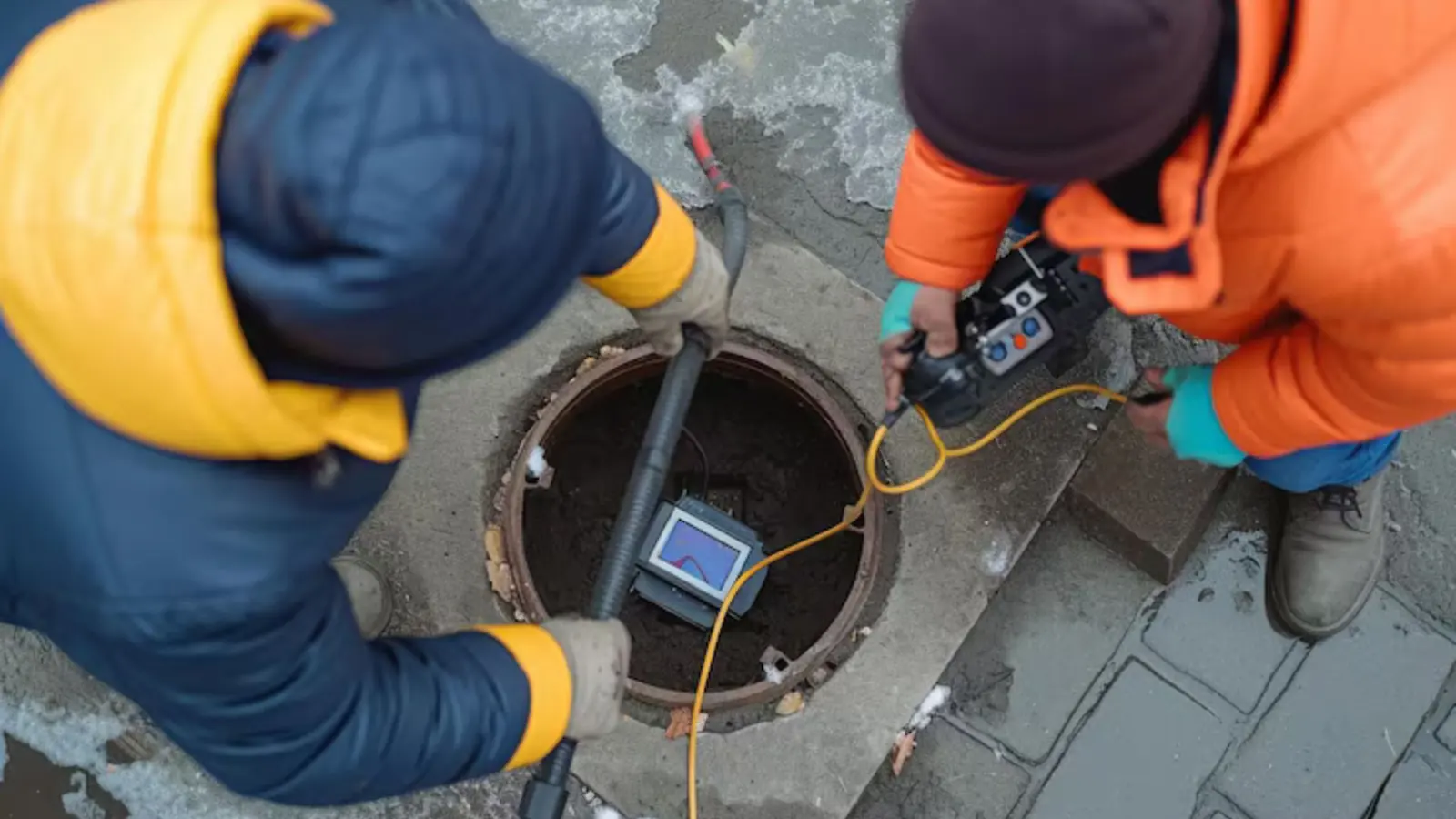
A clogged sewer line announces itself the same way in almost every house: more than one drain slows down, a toilet gurgles when the washer runs, and the lowest drain in the basement starts to rise. If that is happening in your Marlboro home, stop using water and treat it as an emergency, because every flush or load of laundry adds wastewater to a line that has nowhere to go.
This guide explains how to confirm the sewer line is the problem, what a plumber does to clear it, how repair differs from cleaning and what to do in the first hour.
How to tell it is the sewer line and not one drain
A single slow sink is almost always a branch clog close to the fixture. The sewer line is different because everything in the house feeds into it. When it is blocked, the symptoms show up in several places at once and in a pattern.
The lowest fixtures usually fail first, since wastewater backs up to the nearest opening. A basement floor drain that bubbles when the upstairs bathroom is used is a classic sign.
- Two or more fixtures slow or backing up at the same time.
- Gurgling in a toilet or tub when another fixture drains.
- A floor drain that rises or smells when you run water upstairs.
- Water that backs up into a tub when you flush a toilet.
- A backup that returns within weeks of being cleared.
What to do in the first hour
- 1
Stop using water
Hold off on showers, laundry and the dishwasher. Every drop goes into the blocked line.
- 2
Protect the area
Keep people and pets away from wet floors, and lift rugs and boxes off the floor.
- 3
Locate the cleanout
It is usually a capped pipe in the basement, the crawl space or along the foundation.
- 4
Call a plumber
Describe which drains are affected so we can plan the equipment.
How a plumber clears the line
The standard approach is a heavy cable machine fed through the cleanout. A cutting head breaks through the blockage or chops roots, and the cable is withdrawn once water flows freely.
A camera inspection often follows. It shows whether the blockage was a one time event, such as paper or wipes, or a symptom of a crack, a sag or roots that will return. Our sewer line cleaning page walks through the equipment in more detail.
Cleaning is not repair
| Finding | What it means | Usual next step |
|---|---|---|
| Soft blockage, clean pipe wall | A one time clog | Cleaning only |
| Roots at a joint | The pipe has a gap | Cut roots now, plan repair or regular cleaning |
| Belly or sag | A low spot holds waste | Repair or replace that section |
| Cracked or collapsed pipe | The line is failing | Repair or replace the damaged section |
Cleaning restores flow. Repair restores the pipe. If a camera shows damage, clearing the line again and again is money spent without a lasting result, and we will tell you so. See sewer line repair for the options.
What you should not do
Skip chemical drain cleaners for a main line blockage. They cannot reach a deep clog, they sit in the pipe, and they are hazardous to anyone who then works on the line. Avoid flushing repeatedly to see if it clears, which only moves more water into a full pipe.
Do not run a rented power auger through an older line unless you know the pipe material. Clay and cast iron can crack under force, and a damaged pipe turns a simple cleaning into a repair.
How to prevent a repeat
Most repeat blockages trace back to a few habits. Wipes, paper towels and cooking grease are the leading causes, followed by tree roots in older clay or cast iron lines. A camera inspection after any serious backup tells you which one you are dealing with.
If roots are the cause, scheduled cleaning keeps the line open until a repair is done. If grease is the cause, changing what goes down the kitchen drain solves most of it. Keep the cleanout cap accessible, because a buried or painted over cap costs time in an emergency.
What to tell the plumber on the phone
- Which fixtures are slow or backing up, and which one failed first.
- Whether the problem started suddenly or built up over weeks.
- Any recent work in the yard, such as digging or tree removal.
- Whether the home is on public sewer or a septic system.
- Where the cleanout is, if you know.
Sewer line backing up now?
Stop water use and call. We will tell you what to do and book the fastest visit we can.
Marlboro sewer lines: what is worth knowing locally
Marlboro Township grew in waves. The township's growth picked up in the 1950s and 1960s, a suburban boom followed after the early 1970s, and large developments went up through the 1980s and early 1990s. That means many sewer laterals are now 30 to 50 years old or more.
Whether your home is on public sewer or a septic system changes who handles what, so ask the township before assuming. For permits, plumbing in Marlboro is reviewed through the Construction Division at (732) 536-0200, extension 1800, and the township requires a final inspection for new work. Permit rules vary, so ask before a repair that involves digging.
Before any excavation, call 811 so buried lines are marked. Our camera inspection can show you what is under the yard before anyone digs.
Questions homeowners ask
The price depends on whether the line needs cleaning or repair, how deep the damage is and what sits above it. We give a clear price before work starts, so you can compare options.
Yes. Roots enter through small gaps at joints and grow into a dense mat that catches paper and wipes. A camera shows how far they have grown.
It varies by policy and often depends on a specific endorsement. Check your policy, and photograph the damage before cleanup.
Look in the basement near the main drain, along the foundation outside, or in the yard under a small cap. Homes built in different decades place them differently.
Start with a septic professional for the tank, and call us to check the house side of the line. We can tell you whether the pipe is clear to the tank.